|
| 1028 | FCIC Task 7 - Low-Temperature Conversion | The objectives of this task are to determine the effects of biomass feedstock variability on the low- temperature conversion processes (both sugar and lignin pathways) and to develop tools to mitigate the risks posed by this variability. This task meets BETO objectives by developing actionable findings and useful predictions for industrial partners that will enable sustainable production of aviation fuels from low- temperature processes from variable feedstocks, including MSW.
Task 7 Low Temperature Conversion Data
The following collections of data have been generated by FCIC Task 7 Low Temperature Conversion. Their 2023 Task 7 Peer Review Presentation contains overviews of their experimental objectives and methods.
Biolector 48-well Microplate Bioreactor Data - The BioLector instrument from m2p Labs was used in a study to incubate cultures and analyze their growth in real time. The BioLector is a microbioreactor system that allows for continuous online monitoring and control of microbial culture parameters. In this study, the BioLector was used to incubate different strains of microorganisms and monitor their growth under different conditions. The growth data was then used to compare the strains' tolerance to hydrolysate, a byproduct of biofuel production.
Biolector CSV Output Files.zip
Ambr 250 Bioreactor Data Files - The Sartorius Ambr250 system was utilized to model growth and nutrient consumption in a stirred tank environment, demonstrating that a four-fold dilution of DMR-EH concentrate significantly improved biocatalyst performance, particularly for the PA022 strain which struggled in high-throughput BioLector assays at higher concentrations. High hydrolysate concentration testing in the Ambr250 system provided a quick assessment of performance and simulated CMA accumulation seen in fed-batch processes common in large-scale biomanufacturing. Elemental analysis using ICP-OES and ICP-MS correlated the growth of Rhodosporidium biocatalysts in the Ambr250 system with the elemental composition of biomass fractions, revealing that high sodium and sulfur levels in cob samples may hinder growth. Despite low sodium and sulfur levels in husk samples, growth rates were still low, suggesting that other elements at low concentrations could also affect growth.
Amber 250 Bioreactor Data Files.zip
Criticality Analysis - Criticalities and operating ranges for MAs and PPs in sugar- and lignin-conversion processes- In total, the Low-Temperature Conversion team has successfully discovered 33 critical material attributes (CMAs) and more than five critical process parameters (CPPs) for processes that encompass pretreatment, deconstruction, biocatalytic upgrading, and residual lignin valorization unit operations. MAs and PPs were determined to be critical if they caused significant degradation of performance compared to normal operational range observed by the low temperature conversion team. Typically, triggers of criticality were defined as performance (e.g., titer, rate, or yield for the bioconversion unit operation) decreases of 20%. Excel-based data and python scripts used to determine CMAs and CPPs are contained in these folders. In reports that have been written to describe these findings, the criticalities are subdivided into the steps in the biomanufacturing value chain that will ultimately lead to economic production of SAFs, SAF precursors, and community chemicals from agricultural wastes. The CMAs and CPPs are also further delineated into those that are intrinsic to the raw corn stover and those that are process derived (mainly from pretreatment and deconstruction unit operations).
Criticality Analysis Files.zip
Model Training Data -With the aim to understand the effect of material attributes within lignin streams on the conversion performance of Pseudomonas species, experimentation was done to gain in-depth knowledge into the tolerance of these species to feedstock variability. Key outcomes from this project are valuable in assisting with Low-Temperature conversion team/industrial partner interactions to identify the best/new species to optimize SAF production with new processes. Experimentation was done to understand the reductions in growth rate that inhibitors have on Pseudomonas species when utilizing lignin-based feedstocks. To obtain data necessary to train predictive models, four species of Pseudomonas were grown in 96 well plates, with varying concentrations of critical material attributes. Data was collected using a multi-well plate reader and exported as excel files. From there, the data were cleaned and analyzed using Python scripts, in harmony with the methods used in the Criticality Analysis methodologies. This analysis was used to compare industrially relevant species with respect to their metabolic and transport capabilities to enable prediction of the response of new species to material attributes. Data from these experiments can be found in the Modeling Inputs Folder.
Modeling Inputs Files.zip
Model-derived metabolic comparisons - In efforts to create accurate predictions and find in-depth and justifiable outcomes of experimentation, a layered modeling approach was utilized that combined metabolic capabilities of biocatalysts and process performance metrics. For proof of these concepts, these modeling approaches have allowed the Low-Temperature Conversion Team to determine whether Pseudomonas species that are outside of the initial training dataset would be more resistant to particular materials attributes than those species originally evaluated. Understanding strain resiliencies without the need for direct experimental determination, each and every time, would allow new processes in development at industrial facilities to predict reliably whether a process will be impacted. To evaluate and predict with reliability, models were designed that associated metabolic and transport mechanisms with performance in bioreactors that are effected by materials attributes in feedstock streams. Models were validated using leave-one-out validation (LOOV) methods and are reinforced whenever new data became available. The data deployed can be found in the Modeling Inputs folder, and the Python scripts used to wrangle the data and construct models are included as well.
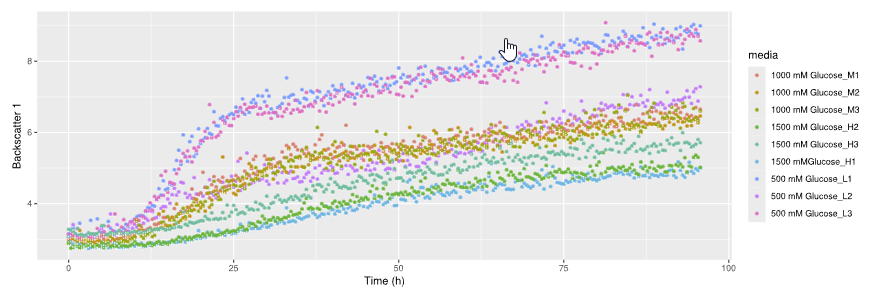
The following is an example of Biolector data plotted in R.
Sample Biolector R Plot
| ANL: Philip Laible, Peter Larsen, Gyorgy Babnigg, Nicholas Dylla, Alex Herte; LBNL: James Gardner, Akash Narani, Deepti Tanjore, Onyinye Okonkwo; NREL: Ed Wolfrum, Jeff Linger, Davinia Salvachua, Ilona Ruhl, Robert Nelson, Xiaowen Chen, Jake Kruger, Rui Ka | True |
11
|
7
|
0
|
4
| False |