From 2019 through 2024, the Feedstock Conversion Interface Consortium (FCIC) operated as a consortium of researchers at nine National Laboratories: Argonne National Laboratory (ANL), Idaho National Laboratory (INL), Lawrence Berkeley National Laboratory (LBNL), Los Alamos National Laboratory (LANL), National Energy Technology Laboratory (NETL), National Laboratory of the Rockies (NLR), Oak Ridge National Laboratory (ORNL), Pacific Northwest National Laboratory (PNNL), and Sandia National Laboratories (SNL) to quantify, understand, and manage variability in biomass from field through downstream conversion and to understand how feedstock composition, structure, and behavior impacts system performance.
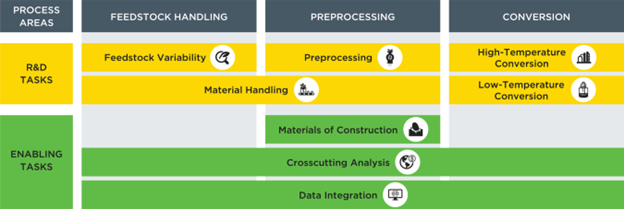
The FCIC was organized into eight complementary tasks that are aligned with operational problem areas. Each task involves contributions from researchers at multiple national laboratories and was designed to provide useful knowledge and tools for bioenergy and bioproducts stakeholders.
Below is a description of each Task in the FCIC, along with a link to the corresponding Data Set that compiles the data, products, and results generated by that Task. To view the complete list of Data Sets produced through the FCIC—as well as additional research hosted in the Bioenergy Feedstock Library—please visit our Data Set page. For more information about the FCIC, please visit the FCIC. To view FCIC publications, please visit our publications page.
FCIC Tasks and Data Sets:
- Task 1 - Materials of Construction: Develop materials that resist wear and can tolerate the range of variability in feedstocks and operating parameters expected for biomass refineries.
Task 1 Data Sets
- Task 2 - Feedstock Variability: Develop tools to quantify and understand the ranges and sources of feedstock physical, chemical, and mechanical variability with the objectives of reducing sources of variability and identification and quantification of critical material attributes (CMAs) in collaboration with other FCIC Tasks.
Task 2 Data Sets
- Task 3 - Material Handling: Solve biomass material feeding and handling problems via a closely integrated multiscale characterization, experimental, and physics-based modeling approach, to develop first principles-based feeding equipment design tools to ensure continuous, steady, trouble-free flow solutions for integrated biorefineries.
Task 3 Data Sets
- Task 4 - Data Integration and Collaborative Computation for Quality by Design: Deploy a collaborative computational environment for hypothesis development, experimental and modeling workflow management, integration of datasets and metadata, algorithm execution, reporting, and deliverable sharing between FCIC subtasks within a uniform Quality by Design (QbD) framework, and a portal for public access to FCIC results, data, and software.
- Task 5 - Preprocessing: Develop science-based design and operation principles that result in predictable, reliable, and scalable performance of preprocessing unit operations and understand how these unit operations influence primary biomass deconstruction.
Task 5 Data Sets
- Task 6 - High-Temperature Conversion: Develop the science-based understanding required to accurately predict the effects of variable feedstock attributes and process parameters on thermal conversion product quality attributes; and use this understanding to predict conversion behavior in thermal conversion reactors.
Task 6 Data Sets
- Task 7 - Low-Temperature Conversion: Determine the effects of biomass feedstock variability on the biochemical conversion process chain and develop tools to mitigate the risks posed by this variability.
Task 7 Data Sets
- Task 8 - Crosscutting Analysis: Develop TEA/LCA tools that enable valuation of intermediate streams and quantify impact of feedstock variability at both a unit operations level and at a system level.
Task 8 Data Sets
FCIC Samples
Through FCIC research, hundreds of physical samples were produced from corn stover and loblolly pine forest residue feedstocks. These samples—along with their associated metadata and available analytical data—are now accessible for public request.
Please visit our Biomass Info page to view the samples currently available and to submit a sample request form.
If you have any questions or comments, please contact [email protected].